
How Play Helps Children Develop Problem-Solving Skills
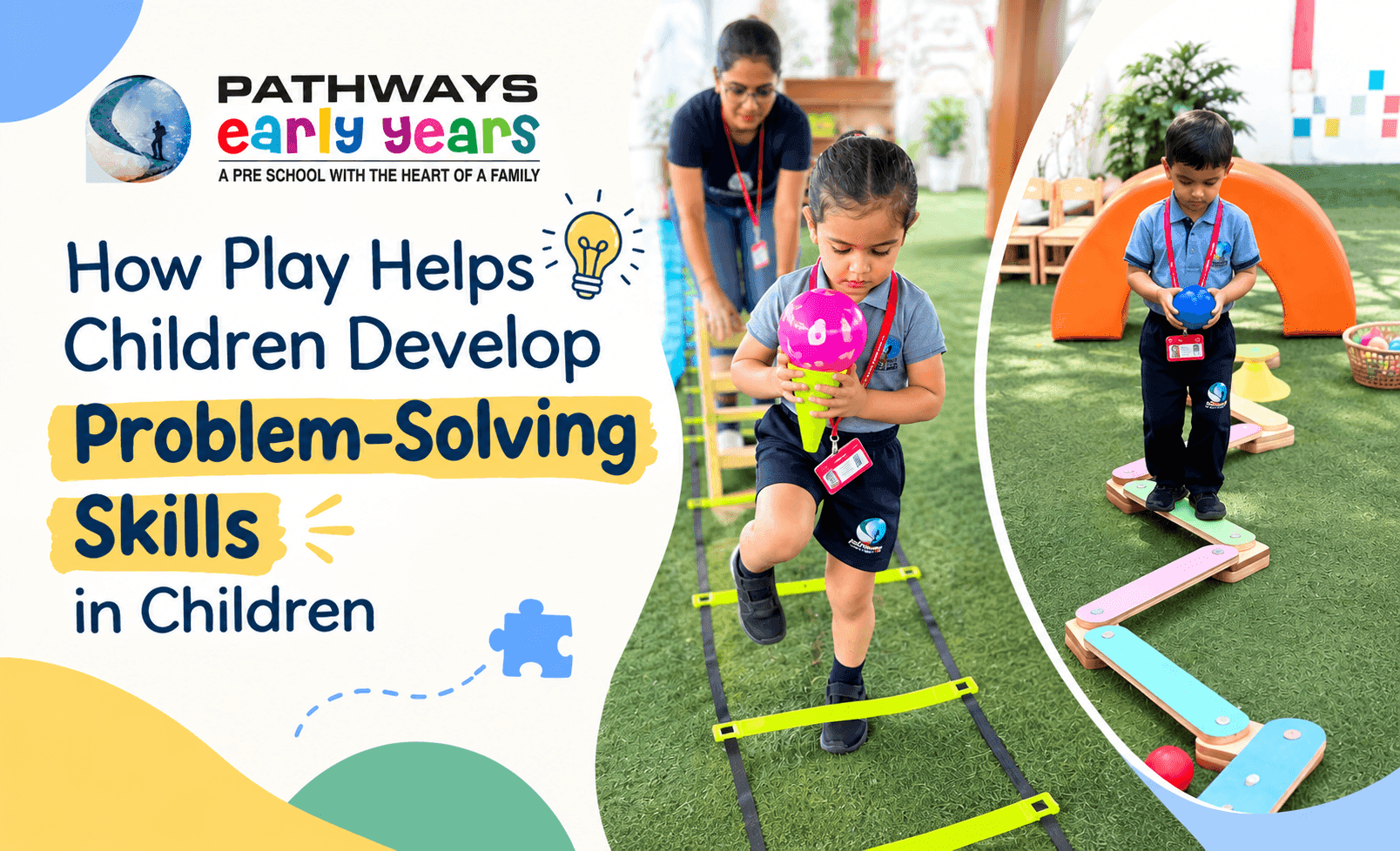
Your child's block tower keeps falling — and that's learning. Here's how everyday play builds problem-solving skills, plus simple activities to try at home.
Watch a child stack blocks, get stuck when the tower wobbles, and try a wider base instead and you're watching problem-solving in action. Parents often think of play as simple fun, something children do between the "real" learning moments of the day. But play is where much of that real learning actually happens.
Problem-solving is one of the most important skills a child can develop. It shapes how they handle schoolwork, friendships, and everyday challenges, both now and later in life. The encouraging part is that children don't need special programmes or worksheets to build this skill. They build it naturally, through play.
How does play help children develop problem-solving skills? Play gives children safe, low-pressure opportunities to face small challenges, test out different solutions, and see what works. Whether they're solving a puzzle, negotiating rules in a group game, or figuring out how to balance a block tower, they practise thinking through problems, adapting when something doesn't work, and trying again — the exact process problem-solving skills in children are built on.
This article looks at what problem-solving actually involves, how different types of play support it, and practical ways parents and educators can encourage it at home and in the classroom.
What Are Problem-Solving Skills in Children?
Problem-solving is the ability to recognise a challenge, think through possible solutions, and choose an approach that works. For children, this doesn't always look like solving a maths equation. It might be figuring out how to reach a toy on a high shelf, working out why a puzzle piece doesn't fit, or deciding how to share a toy fairly with a sibling.
Several underlying skills work together to make problem-solving possible:
Critical thinking — evaluating a situation and weighing up options
Logical thinking — understanding how one action leads to another
Creativity — coming up with original or unexpected solutions
Decision-making — choosing a course of action and following through
Persistence — continuing to try after an initial attempt fails
Flexibility — adjusting an approach when the first idea doesn't work
These skills don't develop in isolation. They grow through repeated, hands-on experience — and play offers exactly that kind of repeated practice, in a context where mistakes are low-stakes and even enjoyable.
How Play Helps Children Develop Problem-Solving Skills
The connection between play and problem-solving skills in children comes down to one simple idea: play presents small, manageable challenges, and children get to work through them independently.
Exploring Different Solutions
During play, children rarely follow a single fixed method. A child building a den might try three different structures before one stays standing. Each attempt is a small experiment, and each failed attempt narrows down what might actually work.
Making Decisions
Play is full of small decisions — which piece to use next, which route to take in a game, which character to be in pretend play. Repeatedly making these choices, and living with the results, helps children build confidence in their decision-making skills in children over time.
Learning From Mistakes
When a block tower falls or a game doesn't go as planned, children experience a low-pressure form of failure. Because the stakes are small, they're more willing to try again rather than give up — an important foundation for resilience.
Developing Logical Thinking
Sorting games, pattern activities, and simple strategy games ask children to notice relationships: this shape fits here, this piece comes next, this move blocks the other player. This is early logical thinking in action.
Building Creativity
Open-ended play, such as imaginative or pretend play, encourages children to invent scenarios, characters, and solutions that don't have a fixed "correct" answer. This kind of creative thinking often transfers directly into flexible problem-solving later on.
Understanding Cause and Effect
Physical play — knocking something over, mixing colours, pouring water between containers — gives children direct, immediate feedback about how actions lead to outcomes. This understanding of cause and effect underpins more advanced reasoning later.
Planning and Organising
Building a structure, setting up a pretend shop, or organising a game with friends all require some degree of planning. Children learn to think a few steps ahead, even if their plans change halfway through.
Developing Persistence
Play rarely rewards children for giving up. A tricky puzzle or a challenging level in a game encourages children to keep adjusting their approach — building the kind of persistence that later supports schoolwork and other long-term tasks.
Types of Play That Support Problem-Solving Skills
Different types of play support problem-solving in slightly different ways. Here's how some common categories contribute.
Pretend and Imaginative Play
What children do: Create scenarios, take on roles, and improvise dialogue or events. Skill developed: Creativity and flexible thinking. Example: A child pretending to run a "café" has to work out what happens when a customer wants something that isn't on the menu, thinking on their feet to keep the game going.
Building and Construction Play
What children do: Use blocks, Lego, or other materials to build structures. Skill developed: Spatial reasoning, planning, and cause-and-effect understanding. Example: A child working out how to stop a bridge from collapsing learns, through trial and error, which structures hold weight and which don't.
Puzzles and Board Games
What children do: Follow rules, take turns, and work toward a goal. Skill developed: Logical thinking and strategic decision-making. Example: A child playing a simple matching game learns to remember card positions and adjust their strategy as the game progresses.
Outdoor Play
What children do: Navigate physical challenges like climbing, balancing, or organising group games. Skill developed: Risk assessment and quick decision-making. Example: A child working out the safest way to climb over an obstacle is problem-solving in a physical, immediate form.
Role-Playing
What children do: Act out real-life or imaginary situations, often with peers. Skill developed: Social problem-solving and negotiation. Example: Two children disagreeing over who plays the "doctor" in a pretend hospital have to negotiate and compromise to keep playing together.
Creative Activities
What children do: Draw, paint, build models, or invent stories. Skill developed: Original thinking and comfort with open-ended problems. Example: A child deciding how to represent "a stormy sky" in a painting has to experiment with colours and techniques rather than follow one correct method.
Group Play
What children do: Play alongside or with other children, often requiring shared rules or goals. Skill developed: Collaboration and conflict resolution. Example: A group deciding on the rules for an invented game has to talk through disagreements and reach a workable solution together.
Most of these play types show up naturally in a well-designed preschool day, where children move between building, pretending, and group activities across the course of a morning.
Why Play-Based Learning Matters in Early Childhood
Play-based learning matters because it keeps children genuinely engaged while they build cognitive skills. When children are curious and interested, they're more likely to persist through a challenge, try different approaches, and remember what they learn.
This doesn't mean structured learning has no place — clear instruction matters too. But play-based learning gives children a chance to apply and practise concepts in a way that feels natural rather than forced. A child who has physically sorted objects by size understands the concept of size differently than a child who has only heard it explained.
Early childhood is a period when children are naturally inclined to explore, experiment, and ask questions. Play-based learning works with this tendency rather than against it, supporting cognitive development, language skills, and social-emotional development at the same time. Even in a longer day care setting, unstructured play time carries the same learning value as more directed activities.
Simple Problem-Solving Play Activities for Children
Parents and educators don't need special equipment to encourage problem-solving. Here are some straightforward options:
Puzzles — Start with simple shape puzzles and gradually increase difficulty as skills grow.
Building blocks — Set an open challenge, such as "build something that can hold a small toy."
Sorting and matching — Sort household items by colour, size, or type.
Simple challenges — Ask a child to figure out how to move an object from one place to another using only certain materials.
Treasure hunts — Create simple clues that require the child to think through each step.
Story-based problems — Pause partway through a story and ask, "What do you think happens next, and why?"
Pattern games — Use beads, blocks, or drawings to continue or create a repeating pattern.
Open-ended creative activities — Provide art materials with no fixed outcome in mind, letting the child decide what to make.
These activities work well because they don't have one rigid "correct" process — they leave room for a child to think, adjust, and arrive at their own solution.
How Parents Can Encourage Problem-Solving Through Play
Parents play an important supporting role, largely by knowing when to step back. Some practical approaches include:
Allow children to try independently before offering help.
Ask open-ended questions, such as "What could you try next?" rather than giving instructions.
Avoid immediately giving solutions — a short pause often gives a child room to work it out themselves.
Encourage experimentation, even if the first few attempts don't succeed.
Let children make mistakes safely, treating errors as part of the process rather than something to avoid.
Praise effort and persistence, not just the final result.
Provide open-ended toys and activities — blocks, art supplies, and pretend-play materials tend to encourage more problem-solving than toys with only one correct use.
None of this requires a special skill set. It mostly involves resisting the urge to jump in too quickly and trusting children to work through manageable challenges on their own.
How Schools Can Support Problem-Solving Through Play
Classrooms can build on the same principles that make play effective at home. Educators can incorporate short, structured play sessions built around open-ended tasks, such as design challenges, group problem-solving games, or collaborative building projects.
Mixing free play with lightly guided activities allows educators to introduce specific skills — such as logical sequencing or basic strategy — while still giving children room to explore their own solutions. Group play activities are particularly useful in a classroom setting, as they naturally introduce negotiation, turn-taking, and shared decision-making alongside academic problem-solving.
A classroom that treats play as a genuine learning tool, rather than only a break between lessons, gives children more consistent opportunities to practise these skills throughout the day. After-school programmes can extend this further, using activity-based sessions to keep children thinking and experimenting beyond regular teaching hours.
Conclusion
Play is easy to underestimate, but it does far more than fill a child's free time. Through building, pretending, sorting, and negotiating with friends, children are constantly practising the skills that make up problem-solving: exploring options, making decisions, learning from mistakes, and thinking creatively about challenges.
The connection between play and problem-solving skills in children isn't about a single activity or toy — it's about giving children regular, varied opportunities to face small challenges on their own terms. Whether at home or in the classroom, treating play as a genuine part of learning, rather than just a break from it, gives children a strong, natural foundation for solving problems throughout their lives.
About the Author
Pathways Early Years Team
Frequently Asked Questions
Play presents small, manageable challenges — like fitting a puzzle piece or balancing blocks — that children work through independently. Repeating this process builds their ability to try different solutions, adjust when something doesn't work, and think through challenges logically.
Pretend play, construction play, puzzles, board games, outdoor play, role-playing, and group play all support problem-solving in different ways, from spatial reasoning and planning to social negotiation and creative thinking.
Play supports cognitive, social, and emotional development simultaneously. It helps children build thinking skills like decision-making and creativity, while also strengthening communication, collaboration, and emotional regulation through interaction with others.
Play-based learning lets children apply concepts hands-on rather than only hearing about them. This active engagement helps ideas stick, encourages curiosity, and gives children repeated opportunities to practise thinking skills in a low-pressure setting.
Puzzles, building blocks, sorting games, pattern activities, treasure hunts, and open-ended creative tasks are all effective. The common thread is that they present a challenge without one fixed method for solving it.
Parents can ask open-ended questions, resist giving immediate answers, and let children attempt challenges independently. Praising effort rather than only success, and allowing safe mistakes, also helps children build confidence in tackling problems.
Get in Touch
Still have questions? Fill out the form below and our team will get back to you shortly.